
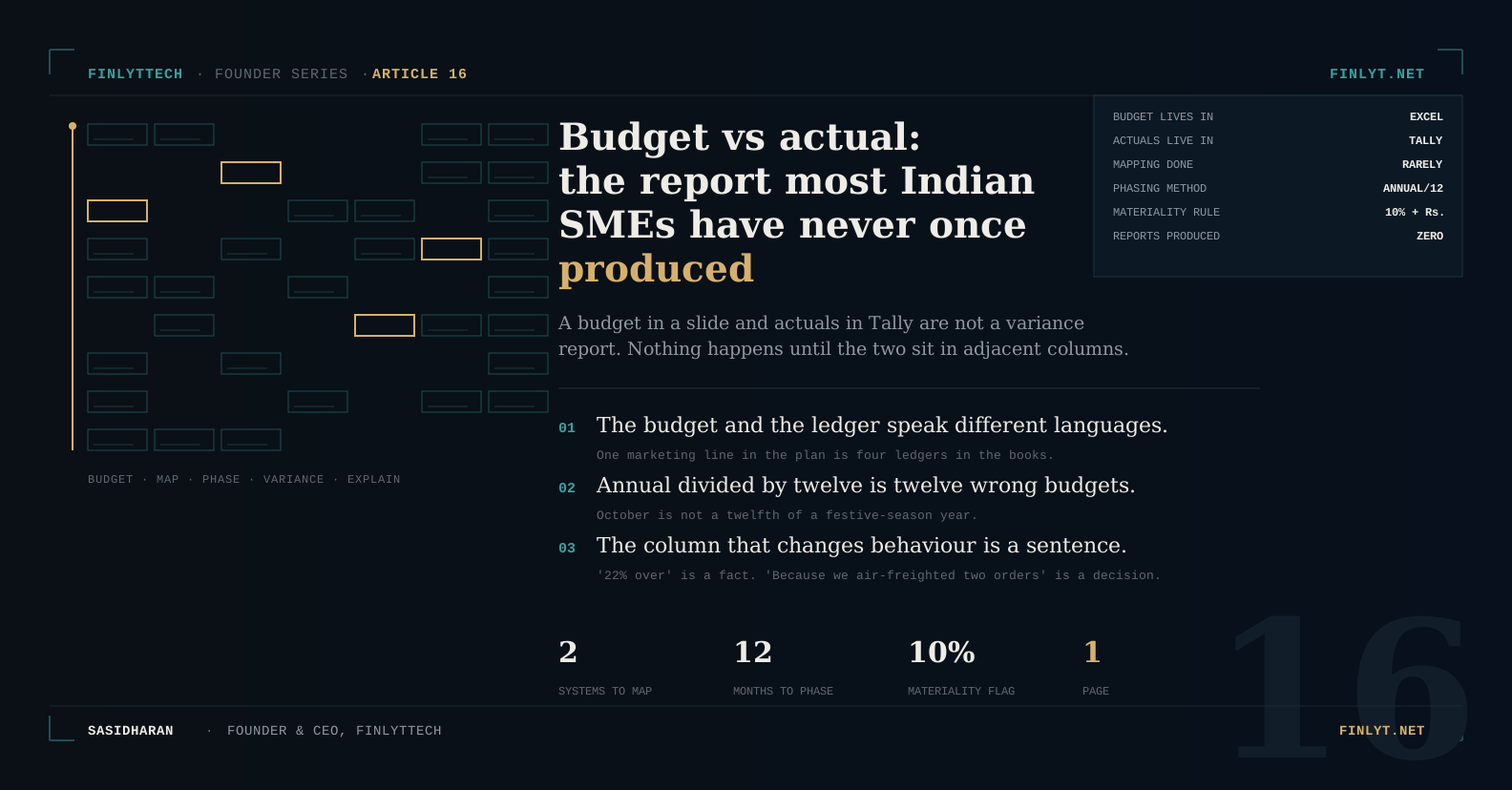
Budget vs actual: the report most Indian SMEs have never once produced
Last quarter I asked a founder running about Rs.40 crore of revenue to send me his budget. He sent a slide. It was from the deck he had used to raise money eighteen months earlier: a revenue line, a gross margin, an EBITDA number and a headcount plan, all annual.
Then I asked for the budget-versus-actual for the year so far. There was a pause.
He had a budget. He had actuals, closed and audited. In eighteen months the two had never once been put in adjacent columns.
This is not unusual. Past the Rs.20 crore mark it is close to the norm, and the reason is not carelessness.
A budget that is never compared to actuals is not a plan. It is a forecast nobody was ever asked to defend.
Why the report does not get produced
Three structural reasons, and none of them is that anyone was lazy.
The budget and the ledger live in different places. The budget is an Excel file on a laptop, with its own line items and its own names for things. The actuals live in Tally or Zoho Books under the chart of accounts. “Marketing” in the budget is four ledgers in Tally, one of which is quietly carrying a subscription that the budget called software. Until somebody maps one to the other, the comparison cannot be produced at all. That mapping is real work, and it is almost never done once and kept.
The budget is annual and the ledger is monthly. An annual number cannot be compared to an April actual without a phasing assumption, and dividing by twelve is the wrong assumption for most Indian businesses.
Nobody owns it. The books get closed, because that is a statutory obligation with a deadline attached. Budget-versus-actual is not a statutory obligation, so it has no deadline, no owner, and no consequence for being absent.
Phasing is the part that makes it honest
Annual divided by twelve is the single most common way this report gets discredited on first use.
If you sell consumer goods, October and November are not a twelfth of your year each. If you sell to government or to large corporates, March is not a twelfth of your collections. Insurance renewals, statutory bonus, audit fees and appraisal-linked increments all land in specific months. Divide by twelve and the report will tell you that you underspent in April and overspent in October. Both statements are true and neither is useful.
Phase it the way the business actually breathes instead: seasonal revenue on last year’s monthly shape adjusted for the plan, salaries on the hiring calendar with increments in the month they take effect, and known annual charges in the month they fall due. It takes a day to do once. After that, it is the thing that makes the variance column mean something.
Divide the annual budget by twelve and you have not built a monthly budget. You have built twelve wrong ones.
Three columns, and the fourth that actually matters
The report itself is not complicated: budget for the month, actual for the month, variance in rupees and in percent, then the same three for the year to date.
But the column that changes behaviour is not a number. It is a sentence: why.
“Freight was 22% over budget” is a fact. “Freight was 22% over budget because we shipped two orders by air to hold a delivery date we had already missed” is a decision waiting to be made. The first gets read. The second gets acted on.
Not every variance deserves your attention
The first budget-versus-actual a business produces usually fails for the opposite reason to the one people expect. It does not fail because the numbers are wrong. It fails because there are ninety line items, sixty of them are off by something, and the reader has no way to tell which four matter.
Set a materiality rule before you look: flag a line only if it is off by more than 10% and by more than a rupee amount worth a conversation in your business. On a Rs.40 crore business that might be Rs.2 lakh a month. Everything under both thresholds is noise, and reporting noise trains people to skim.
Where the CA sits in this
This is work a CA is better placed to do than anyone else in the chain, and it is a natural extension of what the firm already produces.
The mapping between budget lines and the chart of accounts needs exactly the knowledge a CA already holds: which ledgers roll into which head, which costs are being posted inconsistently, and where the chart of accounts needs tightening before any comparison is meaningful. Half the value of the whole exercise shows up in that step, before a single variance is calculated.
The second piece is accrual discipline. A variance report built on a cash-basis month is not a variance report. If the December electricity bill posts in January, December looks under budget and January looks over, and the business will go hunting for an explanation that does not exist. Monthly accruals on the recurring charges are what make a monthly comparison trustworthy, and that is squarely the CA’s craft.
A variance you cannot explain is not a reporting failure. It is the one line on the page that has something to tell you.
Once the mapping and the accruals are in place, the report is the same report every month. It stops being a project and becomes a page.
If your budget and your actuals have never sat in adjacent columns, what exactly is the budget for?
FinLytTech reads your Tally, Zoho Books or ERPNext data, maps it to your budget lines once, and produces the phased budget-versus-actual, the materiality flags and the monthly MIS that sits around them. See it at finlyt.net.
All the best. Read this and more at the FinLytTech Blog: finlyt.net/blog