
In fifteen years of advising founders through M&A and PE transactions, I have seen more businesses damaged by a cash timing gap than by a bad product, a weak market, or a flawed strategy. The P&L said they were doing fine. The bank account said otherwise. And by the time anyone reconciled the two, the damage was already done.
This is not a niche problem. It is the single most common cause of SME distress I have seen up close – more common than competition, more common than poor unit economics, more common than founders running out of ideas. Profitable businesses run out of cash constantly. Almost none of them saw it coming in time to do anything about it.
How a profitable business runs out of cash
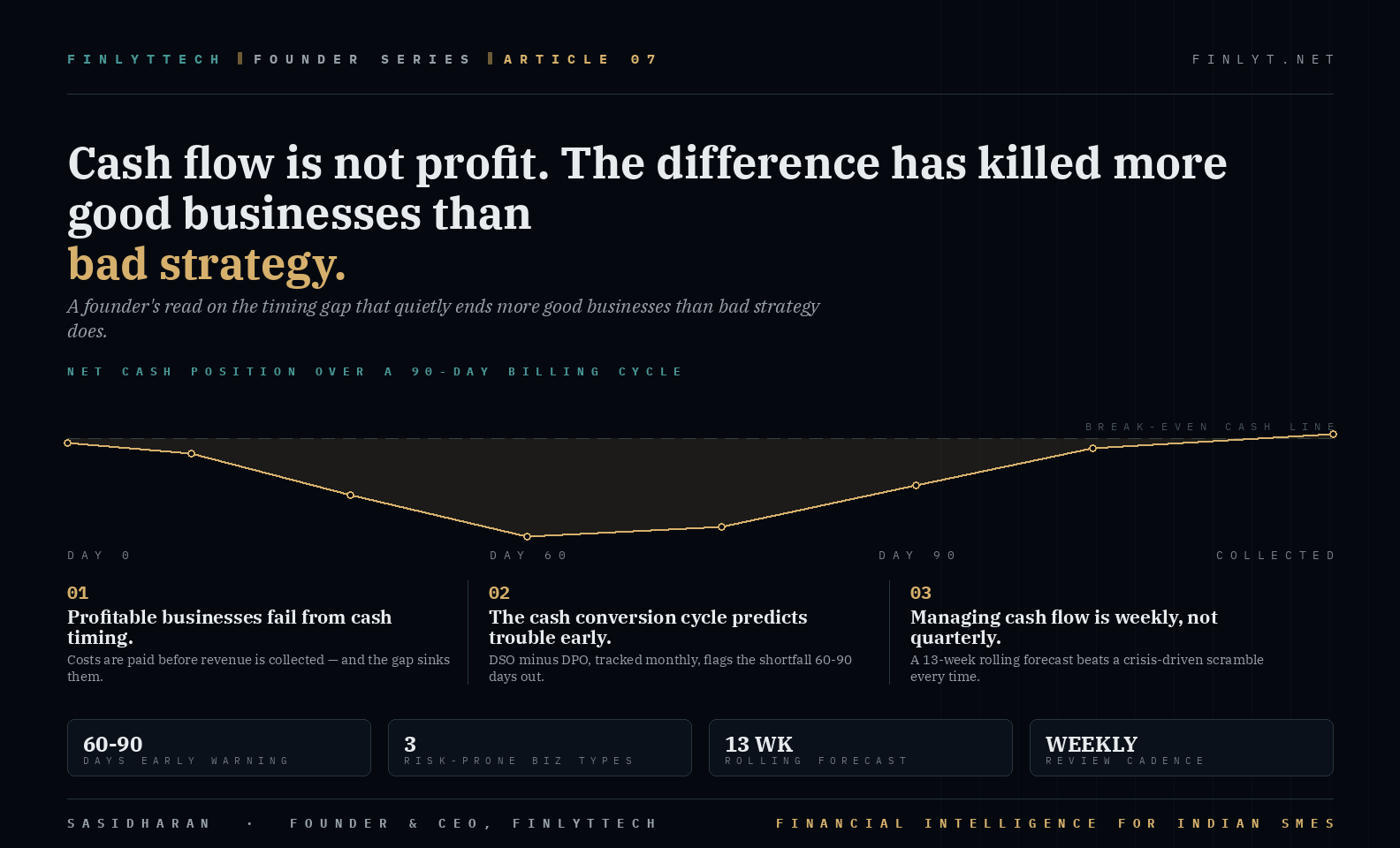
Here is the mechanic, and it is simpler than most founders expect. A business invoices Rs 50 lakh in October. The P&L books that revenue in October – margins look healthy, growth looks strong. But the customer’s payment terms are 60 days, so the cash actually lands in December. Meanwhile, the costs behind that October revenue – materials, wages, subcontractors – were paid in September and October, in cash, on much shorter terms.
For two full months, the business is carrying real, paid-out costs against revenue that exists only on paper. If there isn’t a cash buffer to bridge that gap, the business misses payroll, delays a supplier payment, or takes on expensive short-term debt to cover a shortfall that its own P&L says shouldn’t exist. None of this shows up as a “loss.” It shows up as a crisis that looks, from the outside, like the business is failing – when the business is actually profitable and simply mistimed.
Where this gap is most dangerous
Three kinds of businesses feel this acutely. Project-based businesses – construction, IT services, manufacturing on order – where revenue is recognised on milestones but costs are front-loaded before the milestone bill goes out. Seasonal businesses, where a strong quarter’s revenue is booked well before the cash from that quarter actually clears. And growth-stage businesses, where the instinct to reinvest every rupee of “profit” back into growth ignores that a meaningful share of that profit hasn’t actually arrived as cash yet.
The businesses I’ve watched get into real trouble were rarely unprofitable. They were profitable and cash-blind at the same time – and nobody was watching the gap between the two closely enough to see it coming.
The metrics that predict this 60-90 days in advance
This gap is not invisible. It shows up early, if anyone is tracking the right numbers. Days Sales Outstanding tells you how long revenue takes to become cash. Days Payable Outstanding tells you how long you can hold cash before costs are due. The gap between the two – the cash conversion cycle – tells you, in days, exactly how much working capital your growth requires. Track that number monthly, and a widening gap is visible two to three months before it becomes a payroll problem, not two to three days before.
What “managing cash flow” actually means in practice
It is not a single number checked once a quarter. It is a discipline with three layers: a weekly cash position (what’s in the bank, what clears in the next seven days), a monthly cash flow statement reconciled against the P&L (not assumed to match it), and a rolling 90-day forecast that flags a shortfall while there is still time to act – draw a credit line, renegotiate a payment term, delay a discretionary cost. None of these require sophisticated tooling. They require the discipline to look every week, not every quarter.
A founder’s checklist, if cash surprises are a recurring feature of your business
Five things worth tracking, starting this month: your Days Sales Outstanding trend over the last six months, not just the current number. Your Days Payable Outstanding, and whether it’s shrinking without you deciding it should. Your cash conversion cycle, month over month. A 13-week rolling cash forecast, updated weekly, not assembled from scratch when a crisis hits. And a clear view of which customers or contracts are structurally slow-pay, so growth in that segment is priced and financed accordingly.
How FinLytTech approaches this
FinLytTech pulls the receivables, payables, and cash position straight from Tally, Zoho Books, or ERPNext and turns them into a rolling cash flow forecast automatically – not a quarterly exercise, a standing view that updates as the underlying books do. The goal is not to replace the judgment a CFO or CA brings to a cash crunch. It is to make sure that judgment gets applied 60 days before the crunch, not during it.
Has your business ever been profitable on paper while feeling cash-constrained in practice? What was the underlying cause?
FinLytTech turns your GST and accounting data into a monthly management report automatically – no manual compilation, ready by the 7th of each month. Demo at finlyt.net.