
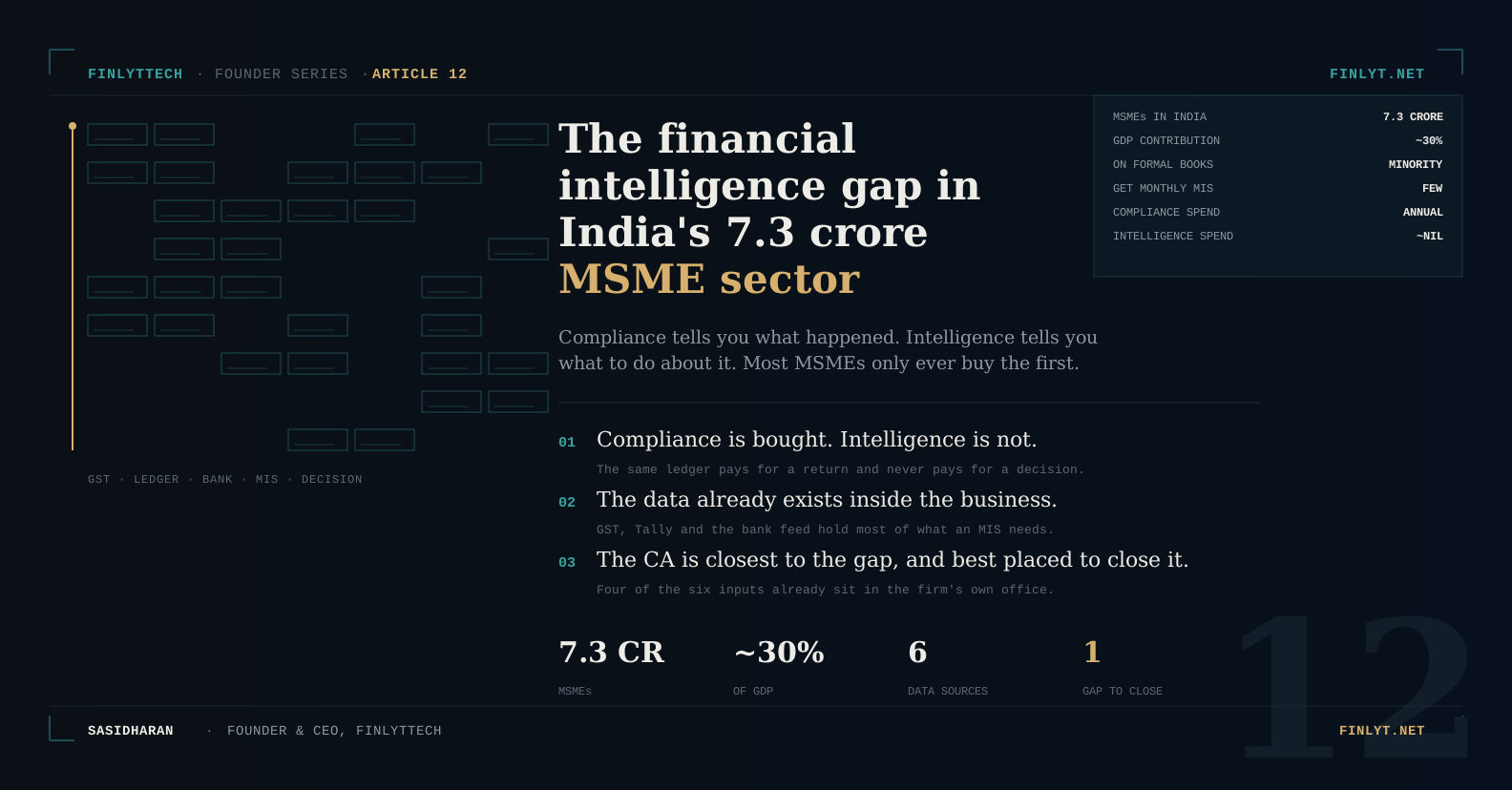
The financial intelligence gap in India’s 7.3 crore MSME sector - and who is closing it
I sat with a founder in Coimbatore last year who runs a Rs.22 crore engineering firm. Second generation, thirty-one years in business, an order book most listed companies would envy. He had a full-time accounts team, a CA firm he had worked with for two decades, and clean Tally data going back to 2009.
I asked him what his gross margin looked like by customer segment. He did not know. Not because the data was missing - it was all in Tally, correctly tagged, correctly posted, checked by someone competent. The data existed. It had simply never been turned into anything he could read.
That is the gap. It is not a data gap. It is an intelligence gap, and it sits on top of the largest concentration of small-business financial data anywhere in the world.
The scale of it
As of February 2026, 7.83 crore enterprises are registered on the Udyam and Udyam Assist platforms - up from 0.79 crore in FY22. GST made a monthly ledger mandatory. E-invoicing pushed structured transaction data into government systems for businesses well below where anyone expected the threshold to land. Tally runs in a large share of Indian SMEs, and Zoho Books and ERPNext account for most of the rest.
So the raw material is there. It is structured, it is monthly, and it is usually accurate - because a Chartered Accountant has already checked it.
What almost none of these businesses have is the layer above it: a monthly P&L read against the prior year, a cash flow statement that actually reconciles, working capital metrics shown as a trend rather than a number, and a forward view of what next quarter looks like if nothing changes. These are the things a CFO produces. They are also the things a Rs.22 crore firm cannot justify hiring a CFO to produce.
The Indian MSME does not have a data problem. It has a rendering problem - the numbers are correct, they are current, and nobody has ever put them in front of the person making the decision.
Why the gap has persisted
Three reasons, and none of them is that founders do not care.
The Western tools were never built for this. FP&A platforms priced at $500 to $2,000 a month assume a finance team of three, a US GAAP chart of accounts, and a data source that is QuickBooks or NetSuite. Drop one into an Indian SME and it fails on all three counts before you even reach GST, TDS, e-invoicing or a financial year that ends in March. The gap is not a translation problem you solve with a currency setting.
Accounting platforms are built for compliance, and they are very good at it. Tally and Zoho Books do precisely what they were designed to do: record transactions correctly and get returns filed on time. Intelligence is a different product with a different job - it has to interpret, compare, project and flag. Asking a ledger to also be an analyst is asking the wrong thing of a genuinely excellent tool.
The channel that could close it is already at capacity. India’s CAs are the only professionals who both understand these businesses and hold the trust required to advise them. The constraint has never been capability - a CA who can sign a set of accounts can certainly build a working capital analysis. The constraint is that building it by hand, every month, across forty clients, competes directly with a compliance calendar that does not move. Judgment is not the scarce input. Hours are.
Who is actually closing it
Three groups are working on this, and it is worth being honest about all three.
Global SaaS moving down-market brings real product depth and serious funding, and carries localisation debt that takes years to pay down. Statutory logic is not a feature you bolt on in a quarter.
Accounting platforms extending upward have the distribution advantage nobody else can match. What they tend to ship is reporting - dashboards layered on the ledger - rather than interpretation. That may change, and if it does they will move fast.
India-native intelligence layers are smaller and newer. They sit on top of Tally, Zoho or ERPNext rather than trying to replace them, and they are built around Indian statutory structure from the first line of schema. FinLytTech is in this third group, so read the assessment above as a position, not a neutral verdict.
What closing the gap actually requires
Four things, in order of how often they are underestimated. Architecture that understands an Indian chart of accounts natively, rather than mapping into a foreign one. A product that sits on the ledger the business already runs, because asking an SME to migrate is asking them to say no. A CA channel treated as the delivery partner rather than the competitor - the right product gives a CA back four hours a month and makes their advice more valuable, not less. And pricing built for a Rs.5 crore business, not a Rs.500 crore one.
There is a compounding effect worth noting. Every Indian SME chart of accounts is idiosyncratic - the same expense sits under three different heads in three different firms. Mapping that correctly gets better with every business onboarded, and that accumulated understanding is not something a well-funded entrant can simply buy.
What 2030 could look like
A founder in Tiruppur opens a monthly report on the fifth, sees that debtor days have drifted from 52 to 61 over two quarters, and calls their CA about it before the bank does. The CA already has the analysis, because it was generated rather than assembled. The conversation is about what to do, not about what the numbers are.
That is not a technology leap. Every input already exists. It is a product that has not been built at scale for this market yet.
What would your business look like if you had CFO-level financial intelligence available every month - not just when you can afford an advisor?
FinLytTech builds the intelligence layer on top of the accounting system you already use - Tally, Zoho Books or ERPNext - with monthly MIS, cash flow, working capital and investor reporting generated automatically, and your CA still in the chair where the judgment happens. See it at finlyt.net.