
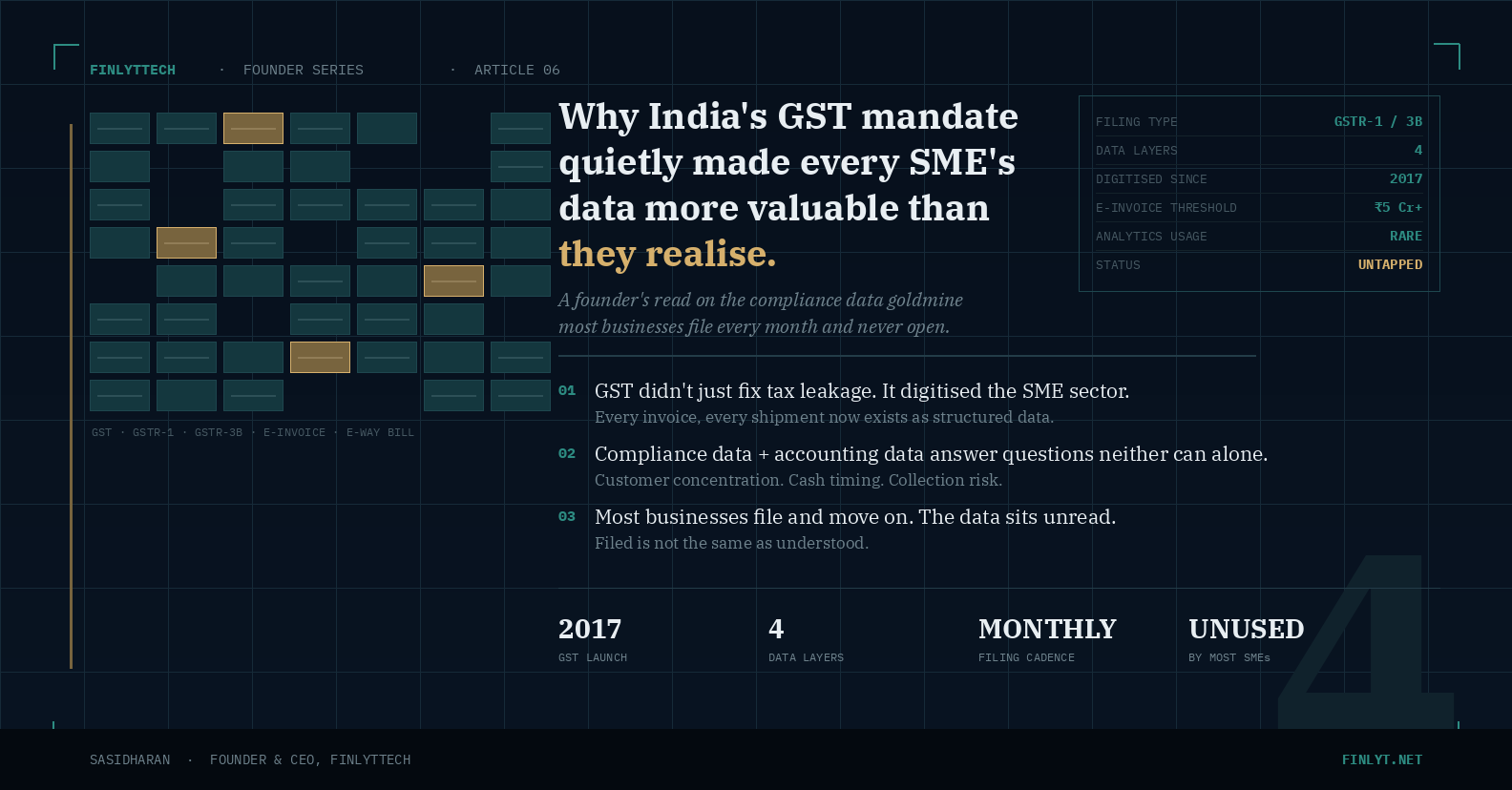
Somewhere between 2017 and today, without most business owners noticing, Indian SMEs went from having almost no structured financial data to sitting on one of the richest transaction-level datasets of any emerging market in the world.
Nobody designed GST for this purpose. It was built to fix tax leakage and unify a fragmented indirect tax system. But the side effect has been enormous: every invoice, every purchase, every movement of goods above a threshold now exists as structured, time-stamped, machine-readable data. And almost none of it is being used for anything beyond compliance.
What actually happened to SME data from 2017 onward
Before GST, a large share of SME transactions in India lived in fragmented registers — VAT here, service tax there, excise somewhere else, and plenty that never touched a system at all. Reconciling it into anything useful required manual effort that most businesses simply didn’t do.
GST changed the unit of record. Every sale above the threshold now generates a return filing. Every invoice above the e-invoicing threshold gets a unique registration number the moment it’s raised. Every shipment above the value threshold generates an e-way bill with origin, destination, and value. None of this existed in a standardised, digital form a decade ago.
The compliance layer that’s quietly building a data asset
GSTR-1 captures every outward supply — customer, value, tax rate, date. GSTR-3B captures the summary position — output tax, input tax credit, net liability. E-invoicing timestamps the transaction at the moment of issue, not at month-end reconciliation. E-way bills add a logistics layer — what moved, when, and to where.
Individually, each of these exists to satisfy a filing requirement. Together, they form a month-by-month, transaction-level ledger of how the business actually operates — revenue timing, customer concentration, seasonal patterns, and movement of goods, all in one place.
Most businesses generate this data every month as a compliance byproduct and never look at it again once the return is filed. The data sits in the GST portal and the accounting software, doing nothing beyond satisfying the filing deadline.
The data most businesses have but have never used analytically
Ask most SME owners what their top five customers contributed to revenue in the last two quarters, and they’ll estimate. The GSTR-1 filings already contain the exact answer, sitting unread.
Ask about seasonality in outward supply by month, or which customers have shifted from monthly to quarterly ordering patterns, or how e-way bill volume tracks against invoiced revenue — in most cases, the honest answer is nobody has looked, because nobody built the habit of looking at GST data as anything other than a filing to get through.
Why this is a genuine advantage, not just a compliance burden
Compare this to SMEs in most other emerging markets. Structured, digitised, government-mandated transaction data at this granularity, across almost the entire formal SME sector, is rare. It’s a byproduct of India’s specific approach to indirect tax reform — and it means Indian SMEs today have a data foundation that businesses of similar size in many other markets simply don’t.
The businesses that will benefit from this tailwind aren’t necessarily the largest ones. They’re the ones that treat GST data as an input to decision-making rather than a monthly obligation to discharge.
What combining GST data with accounting data actually enables
GST data alone tells you what was invoiced and taxed. Accounting data tells you what was collected, what’s outstanding, and what it cost to deliver. Combined, the two answer questions neither can answer alone: which customers are profitable once collection timelines are factored in, whether invoiced growth is translating into cash growth, and where the gap between “billed” and “banked” is widening.
This is the layer most SME reporting skips entirely — because building it manually, every month, is exactly the kind of work that gets deprioritised when there’s a business to run.
How FinLytTech uses this foundation
FinLytTech pulls GST filings and accounting data from Tally, Zoho Books, or ERPNext into a single view — automatically, every month — and turns the compliance byproduct into the intelligence it was always capable of producing: customer concentration, revenue timing, working capital position, and the commentary a CFO would attach to it. Not a replacement for your CA’s compliance work — a use for the data your CA is already helping you file.
When your CA or accountant submits your GST returns, do you ever look at what the data says about your business — or does it end the moment the return is filed?
FinLytTech turns your GST and accounting data into a monthly management report automatically — no manual compilation, ready by the 7th of each month. Demo at finlyt.net.