
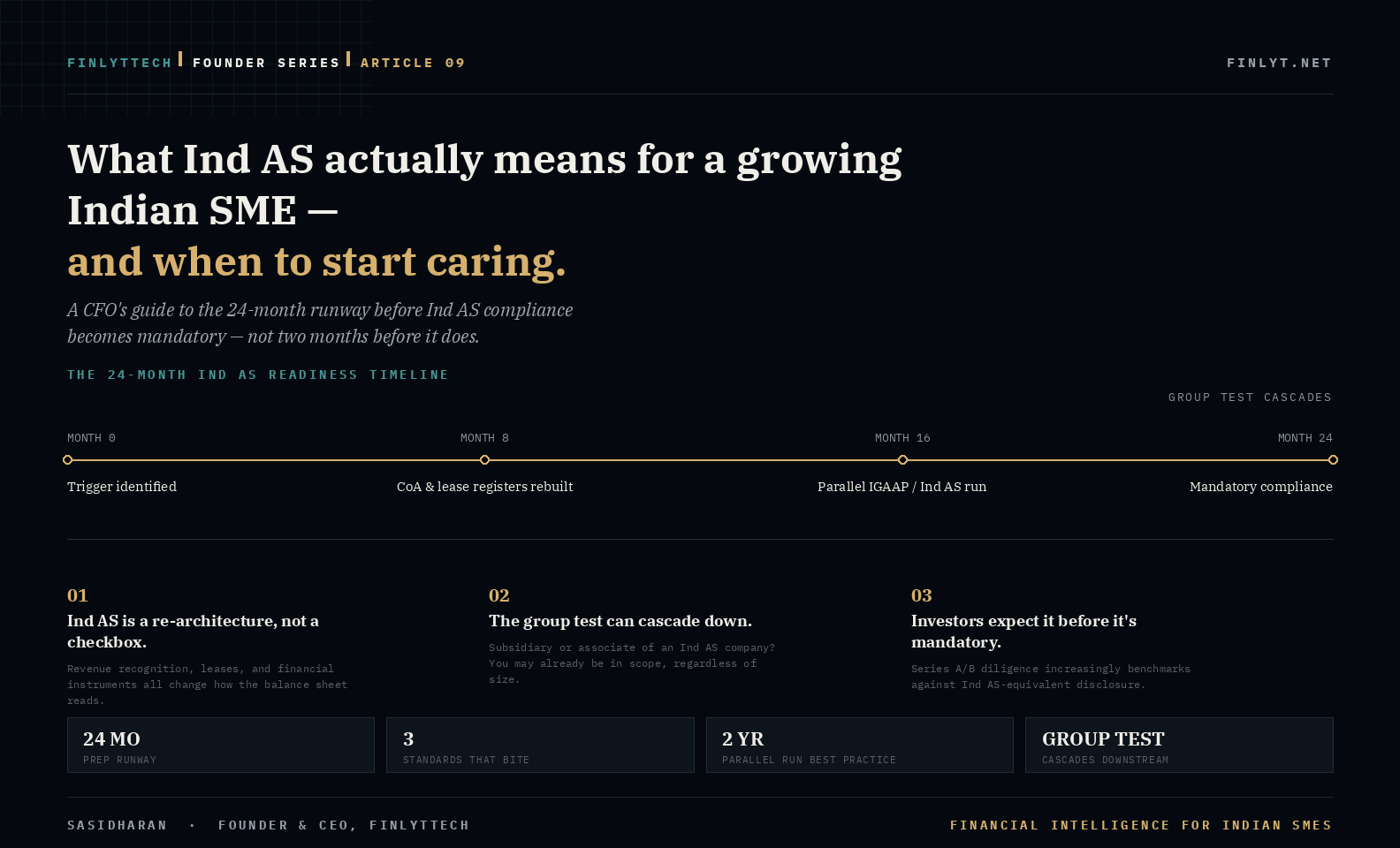
What Ind AS actually means for a growing Indian SME — and when to start caring
Every founder I have worked with has heard of Ind AS. Almost none of them can tell me, with confidence, whether it applies to their company — or when it will.
That gap is not a knowledge problem. It is a timing problem. Most SME founders treat Ind AS as a large-company concern, something that becomes relevant only after the business has scaled well past where they are today. By the time it becomes mandatory, they assume, someone else will have already sorted it out.
The preparation required for Ind AS compliance is best started two years before it becomes mandatory — not two months.
What Ind AS is, and what it is not
Indian Accounting Standards (Ind AS) are India’s convergence with IFRS — a more disclosure-heavy, judgment-intensive framework than the Indian GAAP (IGAAP) most SMEs currently report under. It is not a minor formatting change to your financial statements. It changes how revenue is recognised, how leases are accounted for, how financial instruments are measured, and how much your balance sheet has to say about itself.
The common misconception is that Ind AS is a compliance checkbox you tick once you cross a threshold, done in a single reporting cycle by your auditor. In practice, it is closer to a re-architecture of how your finance function thinks about transactions. Get that timeline wrong, and you are not filing late — you are restating.
The threshold: when does Ind AS actually apply
Ind AS applicability in India is phased by net worth and listing status, rolled out to companies (and their holding, subsidiary, associate, and joint venture entities) above defined net worth thresholds, with unlisted companies brought in after listed ones. The detail that catches SME founders off guard is the group test: if your company is a subsidiary, associate, or JV of a larger entity that is already Ind AS-applicable, the requirement can cascade down to you regardless of your own standalone size.
I have seen founders discover this only when their holding company’s auditor asks for Ind AS-compliant numbers with six weeks’ notice.
The practical implications founders underestimate
Three areas of Ind AS routinely surprise finance teams making the transition for the first time.
Revenue recognition under Ind AS 115 requires you to identify performance obligations within a contract and recognise revenue as each obligation is satisfied — not simply on invoicing or delivery. For SaaS, project-based, and multi-element contracts, this can materially shift when and how much revenue you report in a given period.
Leases under Ind AS 116 bring almost all leases onto the balance sheet as a right-of-use asset and a corresponding liability. A company with a handful of office and warehouse leases that looked lean under IGAAP can see its balance sheet — and its debt-like liabilities — expand meaningfully on day one of adoption.
Financial instruments accounting introduces fair value measurement and expected credit loss provisioning in place of the more mechanical rules under IGAAP. This affects how you carry investments, loans to related parties, and even trade receivables.
None of these are exotic. All of them require data your current systems may not be capturing in the form Ind AS needs.
Why this matters before your Series A, not after
Fundraising founders often assume Ind AS is a post-fundraise problem — something to solve once there is a finance team and a larger cap table to justify the effort. That is backwards. Institutional investors and their diligence teams increasingly benchmark growth-stage companies against Ind AS-equivalent disclosure, even when it is not yet legally mandatory for the company. A founder who can speak fluently about lease liabilities, revenue recognition policy, and expected credit loss — before an investor asks — signals a level of financial maturity that shortens diligence and strengthens negotiating position.
The 24-month runway you actually need
A genuine Ind AS transition needs roughly two years of lead time: one year to restate opening balances and build parallel reporting capability, and a second year to run IGAAP and Ind AS side by side, catch the reconciling items, and train the finance team on the ongoing judgment calls Ind AS requires — lease classification, contract modification, impairment testing. Compress that into a single quarter, and the numbers will not be wrong so much as untested, which is its own kind of risk in front of an investor or a lender.
How a CFO or CA should think about the transition
The right posture is not “wait until it is mandatory.” It is “know your applicability trigger, and start building the data infrastructure two years before you expect to cross it.” That means Chart of Accounts design that already separates the data Ind AS will need, lease and contract registers maintained from day one, and a CA or CFO who is fluent in both frameworks rather than fluent in IGAAP and reading Ind AS for the first time when the letter arrives.
Is Ind AS on your financial team’s radar, or is it something you are planning to address “when the time comes”?
FinLytTech builds the financial data infrastructure — clean Chart of Accounts, lease and contract tracking, audit-ready MIS — that makes an Ind AS transition a planned project instead of a scramble.
All the best — read this and more at the FinLytTech Blog: finlyt.net/blog