
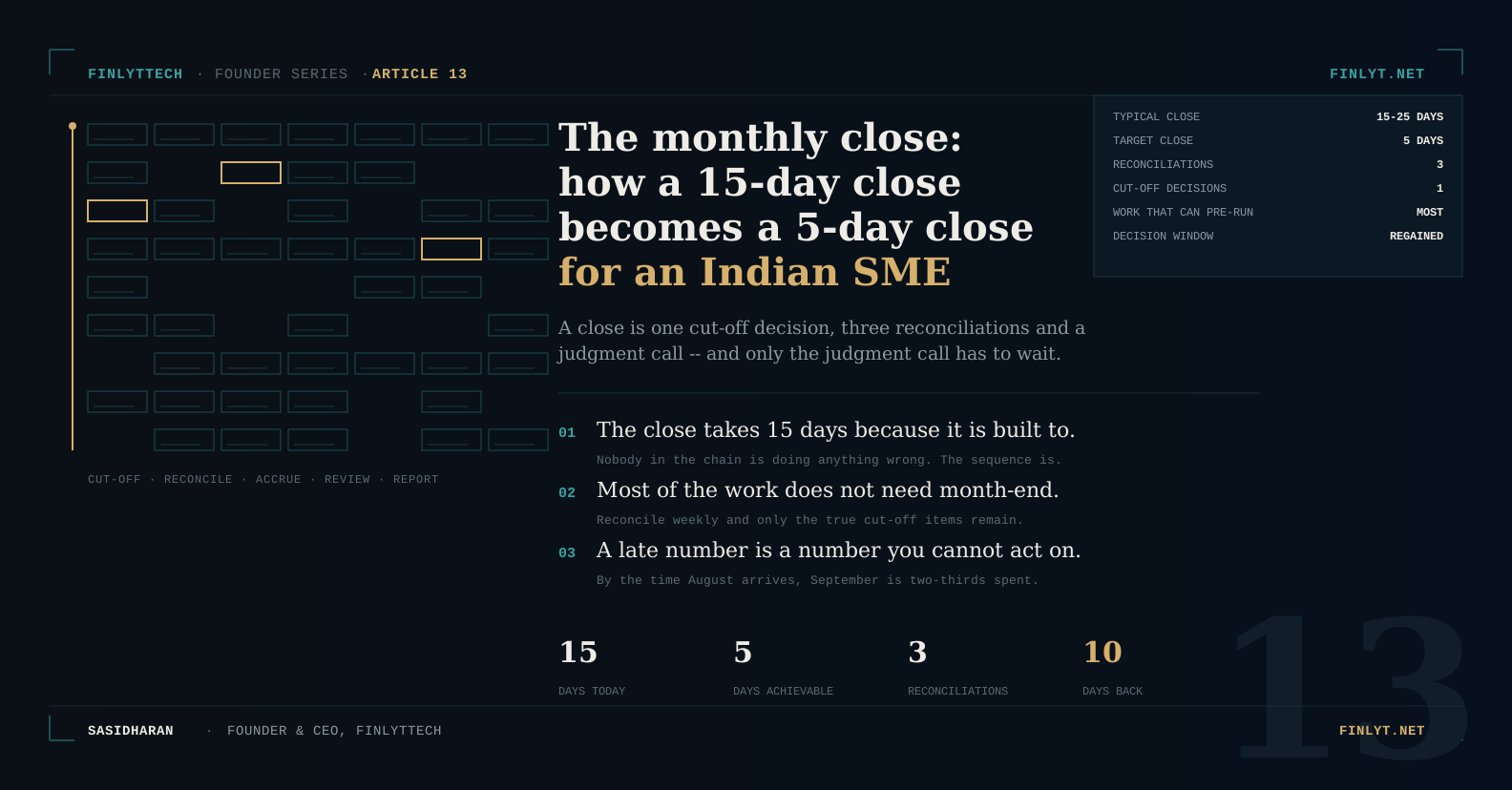
The monthly close: how a 15-day close becomes a 5-day close for an Indian SME
Every management decision a business makes in a month is made on last month’s numbers. So the date those numbers arrive is not an accounting detail. It is the date the business regains its eyesight.
In most Indian SMEs I have worked with, that date falls somewhere between the 15th and the 25th. By the time the founder sees August, September is more than half spent. Whatever the numbers reveal – a margin slipping, a customer stretching payment, a category quietly bleeding – the window to respond has already closed on two-thirds of the following month.
Nobody in that chain is doing anything wrong. The close takes fifteen days because it is structured to take fifteen days.
Why the close slips, structurally
Three things collide in the first three weeks of every month, and none of them are within the accounts team’s control.
The first is the compliance calendar. GSTR-1 is due on the 11th. GSTR-3B on the 20th. TDS payment on the 7th. For a small accounts team – and for the CA firm supporting them – those are hard statutory deadlines with penalties attached. A management report has no penalty attached. When the two compete for the same pair of hands in the same week, the report loses, every single month, and rightly so.
The second is that inputs arrive late. Vendor invoices for the last week of the month land in the first week of the next. Bank statements for the closing days are downloaded days later. GSTR-2B is only generated on the 14th, so any purchase-side reconciliation that waits for it cannot start earlier.
The third is that the close is treated as one large task rather than several small ones. It begins when the month ends, which means every reconciliation, every accrual, every stock adjustment is discovered fresh, in the same compressed week, by people who are also filing returns.
What a close actually consists of
Strip it back and there are five blocks, and only one of them genuinely needs to happen after the month ends.
Cut-off – deciding what belongs in the month. Which dispatches, which bills, which advances.
Reconciliations – bank, GST (2B against the purchase register), and inter-branch or inter-entity balances.
Accruals and provisions – salaries, rent, interest, electricity, and the recurring expenses that arrive as bills after the period they relate to.
Stock and work-in-progress – physical position, valuation, and anything in transit.
Review and commentary – the judgment layer. Does this look right, and what does it say?
A close is not a data-entry exercise. It is one cut-off decision, three reconciliations, and a judgment call – and only the judgment call genuinely has to wait for the month to end.
The five moves that compress it
Set a hard vendor cut-off and publish it. Bills received after the 3rd go to the next month. This sounds like a compromise on accuracy; in practice it converts an unbounded wait into a fixed one, and materially misstates nothing if applied consistently.
Reconcile the bank continuously, not at month-end. A daily or twice-weekly bank reconciliation removes the single largest source of month-end surprise. On the 1st, you are reconciling two days, not thirty.
Move GST reconciliation off the critical path. Reconcile the purchase register against GSTR-2B weekly through the month. The 14th then confirms what you already know instead of starting the exercise.
Keep a standing provisions schedule. Most accrual entries are the same twelve or fifteen line items every month. A maintained schedule turns rediscovery into review – often a thirty-minute job instead of two days.
Separate the close from the report. These are two different pieces of work, and merging them is why both run late. Freeze the ledger, then produce the report from frozen data. The report should not be waiting on one pending bill.
The part that should not be compressed
The review layer. The five minutes where someone who understands the business looks at the gross margin and says that is not right, check the freight allocation – that is the entire value of a close, and it is the part that gets squeezed to nothing when the mechanical work overruns.
This is exactly where your CA earns their fee, and the reason to compress the first four blocks is to give the fifth the time it deserves. Every CA firm I speak to says a version of the same thing: the capability to interpret has never been the constraint. The constraint is that interpretation competes with reconciliation for the same week, and reconciliation has the statutory deadline.
What it looks like when it works
A ₹28 crore distribution business I worked with was closing on the 18th, sometimes the 22nd. Nothing about the team changed. A published vendor cut-off on the 3rd, a twice-weekly bank reconciliation, a standing provisions schedule, and weekly 2B matching moved the close to the 6th.
Twelve days earlier does not sound dramatic until you translate it: the founder now reviews August in the first week of September, with three weeks left to act on it, instead of ten days. Over a year, that is roughly four additional months of decision-making time recovered from a process that produced exactly the same numbers.
If your management numbers arrive on the 18th, how many decisions did you already make that month without them?
FinLytTech automates the mechanical half of the close – bank and GST reconciliation, standing accruals, and the report itself – from your Tally, Zoho Books or ERPNext data, so the review happens by the 7th instead of the 20th. See it at finlyt.net.
All the best – read this and more at the FinLytTech Blog: finlyt.net/blog