
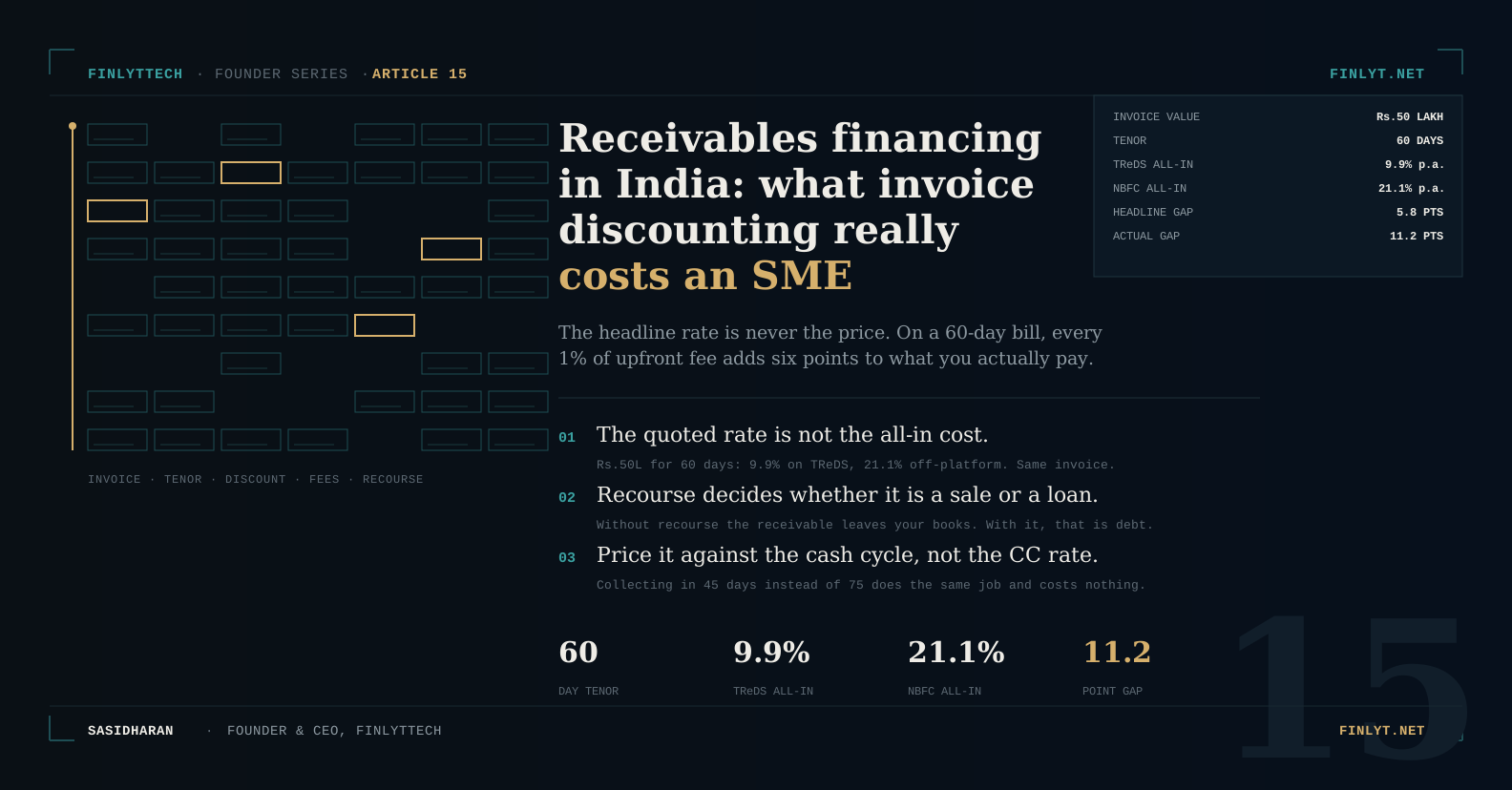
Receivables financing in India: what invoice discounting really costs an SME
A founder told me last month that he had “got invoice discounting at eleven percent.” He was pleased. On the face of it he had every right to be: his cash credit limit was at 9.75%, and this was unsecured, off his drawing power, and funded in two days.
I asked him what he had actually paid on the last bill he discounted. He sent the statement. On a Rs.38 lakh invoice discounted for 52 days, he had paid Rs.57,200 in discount charges and Rs.38,000 as a processing fee. That is Rs.95,200 on Rs.38 lakh for 52 days.
Annualised, that is not eleven percent. It is 17.6%.
He had not been misled. Every number was disclosed. Nobody had done the arithmetic.
The quoted rate is not the all-in cost
Receivables financing is priced on a short tenor, and that is what makes the headline rate so misleading. A fee that looks small as a percentage of the invoice becomes very large when you spread it over sixty days instead of a year.
Take a Rs.50 lakh invoice at a 60-day tenor.
On a TReDS exchange at a 9.25% discount rate, the charge is Rs.76,027, plus roughly Rs.5,000 in platform and transaction fees. Total Rs.81,027, or 1.62% of face value. Annualised: 9.9%.
The same invoice with an off-platform NBFC quoting 15%, with a 1% processing fee on drawdown: Rs.1,23,288 in discount plus Rs.50,000 in fees. Total Rs.1,73,288, or 3.47% of face. Annualised: 21.1%.
The gap in the headline rates is 5.8 percentage points. The gap in what you actually pay is 11.2.
The rule to carry around: on a 60-day facility, every 1% of upfront fee adds about 6 percentage points to the annualised cost. On a 30-day facility it adds 12.
Three channels, three different prices
TReDS: the RBI-regulated exchanges, RXIL, M1xchange and Invoicemart. Financiers bid on your accepted invoice, and the winning bid is usually priced off your buyer’s credit rating rather than yours. For a small supplier to a large, well-rated corporate this is the single cheapest receivables money available in India, and it is the channel most SMEs still do not use. Since the onboarding threshold came down to Rs.250 crore of turnover, the list of buyers already registered is far longer than most suppliers assume, so it is worth checking before concluding your customers are not on it.
Bank bill discounting: cheaper than an NBFC, usually carved out of your existing limits, and therefore not additional liquidity at all. It also normally comes with recourse.
NBFC and fintech discounting: fastest, most flexible, most expensive, and almost always with recourse. This is the right channel when speed genuinely matters. It is the wrong channel when it has quietly become the permanent working capital line.
Recourse is the whole question
This is where the accounting and the risk sit, and it gets very little attention in the sanction conversation.
Without recourse, the buyer’s acceptance transfers the credit risk to the financier. The receivable comes off your balance sheet. Debtor days fall, the current ratio improves, and, as anyone who read the piece on credit files will recognise, the picture a banker sees genuinely changes.
With recourse, nothing has been sold. If the buyer does not pay, you repay. The receivable stays on your books and the funding sits there as a borrowing, which is exactly how your next lender will read it. A founder who believes he has sold Rs.2 crore of receivables, when what he has actually done is borrow Rs.2 crore against them, is carrying a contingent liability he has not priced.
Discounting does not create cash. It buys days, and the only question worth asking is whether those days cost less than what you will do with them.
What it should be compared against
Not your cash credit rate. Cash credit is secured, on drawing power, and limited. Discounting is incremental liquidity on a specific invoice. They are different instruments and the comparison flatters the wrong one.
Compare it instead to the three real alternatives. To the cost of the cash cycle itself: if collecting in 45 days instead of 75 has the same effect and costs nothing, the discounting was a way of paying 10% to avoid a phone call. To the return on what the money funds: a 21% facility financing a 30% gross margin order is sound, and the same facility covering a salary run is not. And to the early-payment discount you may already be offering: 2% for settlement 45 days early is 16.2% annualised, which is often more expensive than the discounting you were considering instead.
Where the CA sits in this
Two pieces of this are squarely a CA’s work and rarely get done.
The first is the effective-cost calculation: discount, processing fee, platform charge, stamp duty and unused-limit commitment, converted to a single annualised number per facility, compared side by side. It takes twenty minutes per lender and almost nobody does it before signing.
The second is derecognition. Whether a factoring arrangement qualifies as a sale or remains a borrowing turns on the transfer of risks and rewards, and it drives the balance sheet, the ratios and the disclosure. Getting that wrong does not show up as a problem until the next credit assessment, when the numbers do not agree with the loan statements.
Do you know the all-in annualised cost of every receivables facility you are currently using, as one number, per lender?
FinLytTech reads your Tally, Zoho Books or ERPNext data and produces the bucketed debtor ageing, the facility-level effective cost, and the monthly MIS that sits underneath both. See it at finlyt.net.
All the best. Read this and more at the FinLytTech Blog: finlyt.net/blog