
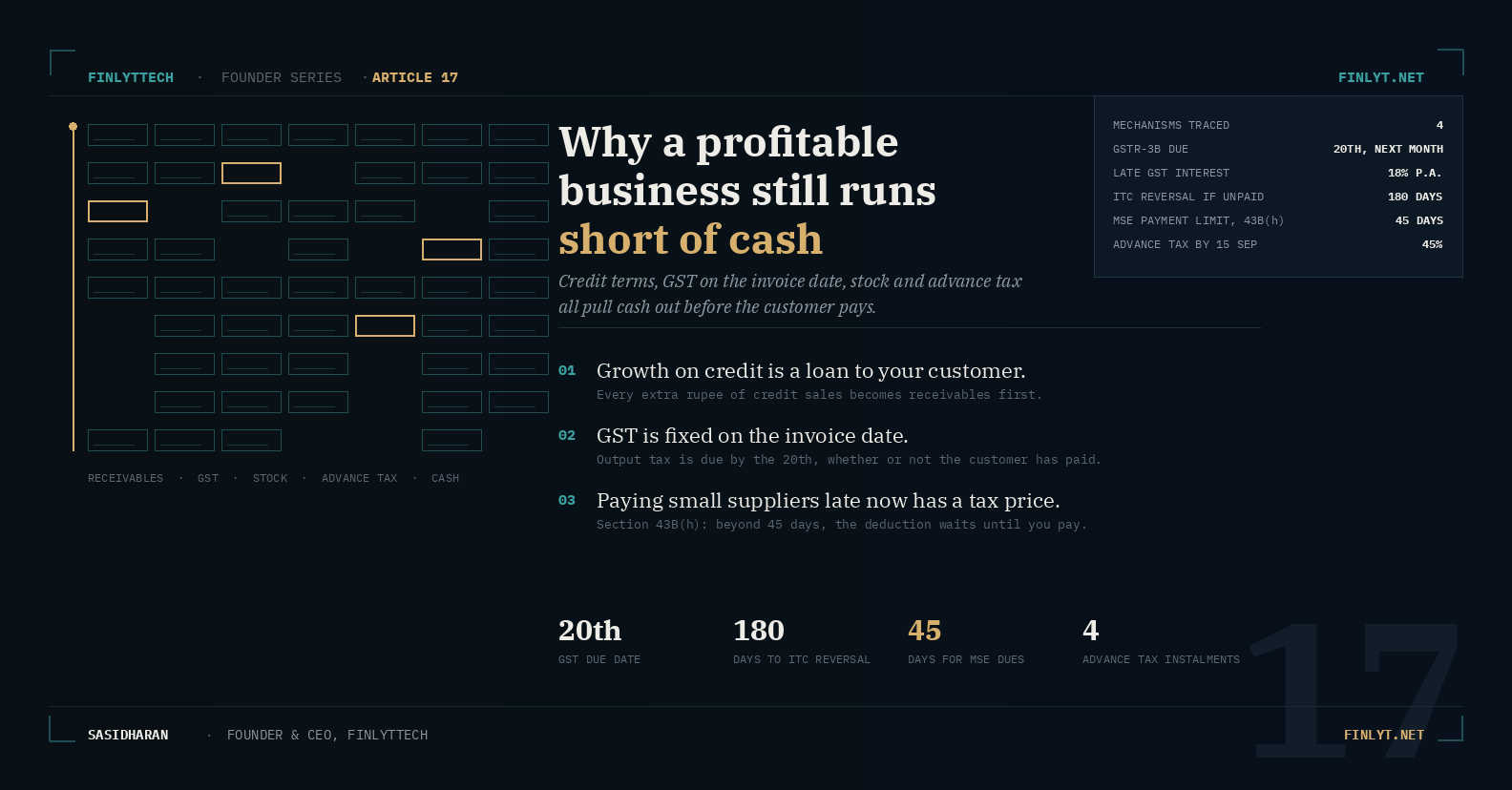
Why a profitable business still runs short of cash
The month closes, the profit and loss statement shows a healthy number, and on the same morning the bank balance will not cover the salaries due at the end of the week. Almost every owner I have worked with has lived through that morning at least once. The first instinct is to suspect an error in the books. Usually there is none. The books are right, and the cash is right, and the two are simply measuring different things.
Profit records a sale on the day it is invoiced and a cost on the day it is incurred. Cash records money on the day it moves. Between those two sets of dates sits a whole machinery of credit terms, tax rules and stock decisions, and in Indian businesses that machinery almost always runs in one direction: it pulls cash out earlier than it brings cash in.
Where does the profit sit, if it is not in the bank?
The largest part usually sits with customers. A sale made on thirty, sixty or ninety day terms is profit on the invoice date and cash only when the customer pays. When sales are flat, last quarter’s collections roughly fund this quarter’s credit. When sales grow, every additional rupee of revenue on credit adds a rupee of receivables before a single paisa of it reaches the bank.
Every rupee of growth sold on credit is a rupee you have lent to your customer before you have been paid.
This is why growth is often the moment a business discovers its cash problem. The profit and loss statement is celebrating the same sales that the bank account is quietly funding. The right question to ask of a profitable month is how much of that profit has already been converted, and by whom.
Why am I paying tax on money I have not collected?
GST ties tax to the invoice. Under Section 12 of the CGST Act, the time of supply for goods is the earlier of the date the invoice is issued (or was due to be issued) and the date payment is received, as the Masters India explainer on time of supply sets out. For a normal credit sale, that means the invoice date. The tax collected on that invoice is payable with GSTR-3B by the 20th of the following month for monthly filers, according to ClearTax’s GSTR-3B guide, with interest at 18 per cent a year if it is paid late.
So the business pays output GST out of its own pocket on sales whose cash may be two or three months away.
GST is fixed on the day you raise the invoice, and your customer’s payment date plays no part in it.
The same logic runs on the purchase side. Under the second proviso to Section 16(2) of the CGST Act, read with Rule 37, a buyer who does not pay the supplier within 180 days of the invoice date must reverse the input tax credit taken, with interest, and can reclaim it only once payment is made, as TaxGuru’s note on the 180-day condition explains. Holding back supplier payments to conserve cash eventually turns into an extra GST outflow.
What is the warehouse doing to the bank balance?
Stock is cash that has changed shape. Raw material bought and paid for, finished goods waiting in a godown, spares bought in bulk to get a better rate: all of it has left the bank, and none of it touches the profit and loss statement until it is sold or consumed. A business can report exactly the same profit in a month where it built a season’s worth of inventory as in a month where it built none.
I have sat in reviews where the stock number was treated as a comfort, proof that the business had “assets”. A lender reads it differently, and so should an owner. Every week of cover beyond what the business actually needs is money that could have paid a vendor, a tax instalment or a salary.
Why does the tax calendar squeeze a growing business harder?
Income tax on profit is computed on an accrual basis, and it is paid in advance. Any taxpayer whose estimated liability for the year exceeds ten thousand rupees after TDS pays advance tax in four instalments: 15 per cent by 15 June, 45 per cent by 15 September, 75 per cent by 15 December and the full amount by 15 March, as ClearTax’s advance tax guide for FY 2026-27 lays out. Those instalments fall due whether or not the customers behind that profit have paid.
The tax law has also closed one of the oldest escape valves. Section 43B(h), inserted by the Finance Act, 2023 with effect from assessment year 2024-25, allows a deduction for sums owed to a registered micro or small enterprise only if they are paid within the time limit in Section 15 of the MSMED Act: 15 days without a written agreement, and no more than 45 days with one, according to TaxGuru and ClearTax. Pay late and the expense is deductible only in the year you actually pay. The provision carries into section 37 of the Income-tax Act, 2025, which applies from 1 April 2026, per TaxGuru’s section 37 analysis.
Stretching a small supplier used to be the cheapest money in the business, and the tax law has now attached a price to it.
How do you see the gap before it bites?
The practical answer is a bridge from profit to cash, built every month and read line by line. Start with profit. Adjust for the change in receivables, the change in inventory and the change in payables. Show GST paid against GST actually collected from customers. Show advance tax, loan principal and capital spending. What remains should reconcile to the movement in the bank balance, and if it does not, that difference is the first thing to chase.
Two habits make the bridge useful. The first is reading receivables customer by customer, because a total hides the one account that has quietly stopped paying. The second is putting every obligation on the date it falls, because a month that nets out positive can still contain a week that does not.
Your chartered accountant builds a version of this bridge at year end, in the cash flow statement, and the discipline behind it is exactly right. Its timing is set by the annual close, while the decisions it should inform happen every week. The owner needs the same view monthly, and ideally weekly.
This is the first thing Cashflow Analytics, the entry Solution at FinLytTech, builds from the books a business already keeps: where the cash came from, where it went, who owes us, who we owe, and how long the business can last. Every figure on the screen traces back to a posted voucher.
When your last profitable month closed, could you have named the three places the cash went before the bank statement told you?
Sources
- Masters India, “Time of Supply of Goods: Section 12 of CGST Act”: https://www.mastersindia.co/blog/time-of-supply-of-goods-cgst-act-section-12/
- ClearTax, “GSTR-3B: Due Date, Late Fee, Format”: https://cleartax.in/s/gstr-3b
- TaxGuru, “180-Day Payment Condition under GST”: https://taxguru.in/goods-and-service-tax/180-day-payment-condition-gst.html
- ClearTax, “Advance Tax FY 2026-27: Due Dates, How to Calculate”: https://cleartax.in/s/advance-tax
- TaxGuru, “Section 43B(h): Pay timely to Micro / Small Enterprise(s) or Pay Taxes”: https://taxguru.in/income-tax/section-43bh-pay-timely-micro-small-enterprises-pay-taxes.html
- ClearTax, “Section 43B(h) of Income Tax Act”: https://cleartax.in/s/section-43bh-of-income-tax-act
- TaxGuru, “Section 37 of Income Tax Act 2025 (Earlier Section 43B)”: https://taxguru.in/income-tax/section-37-income-tax-act-2025-earlier-section-43b-income-tax-act-1961.html