
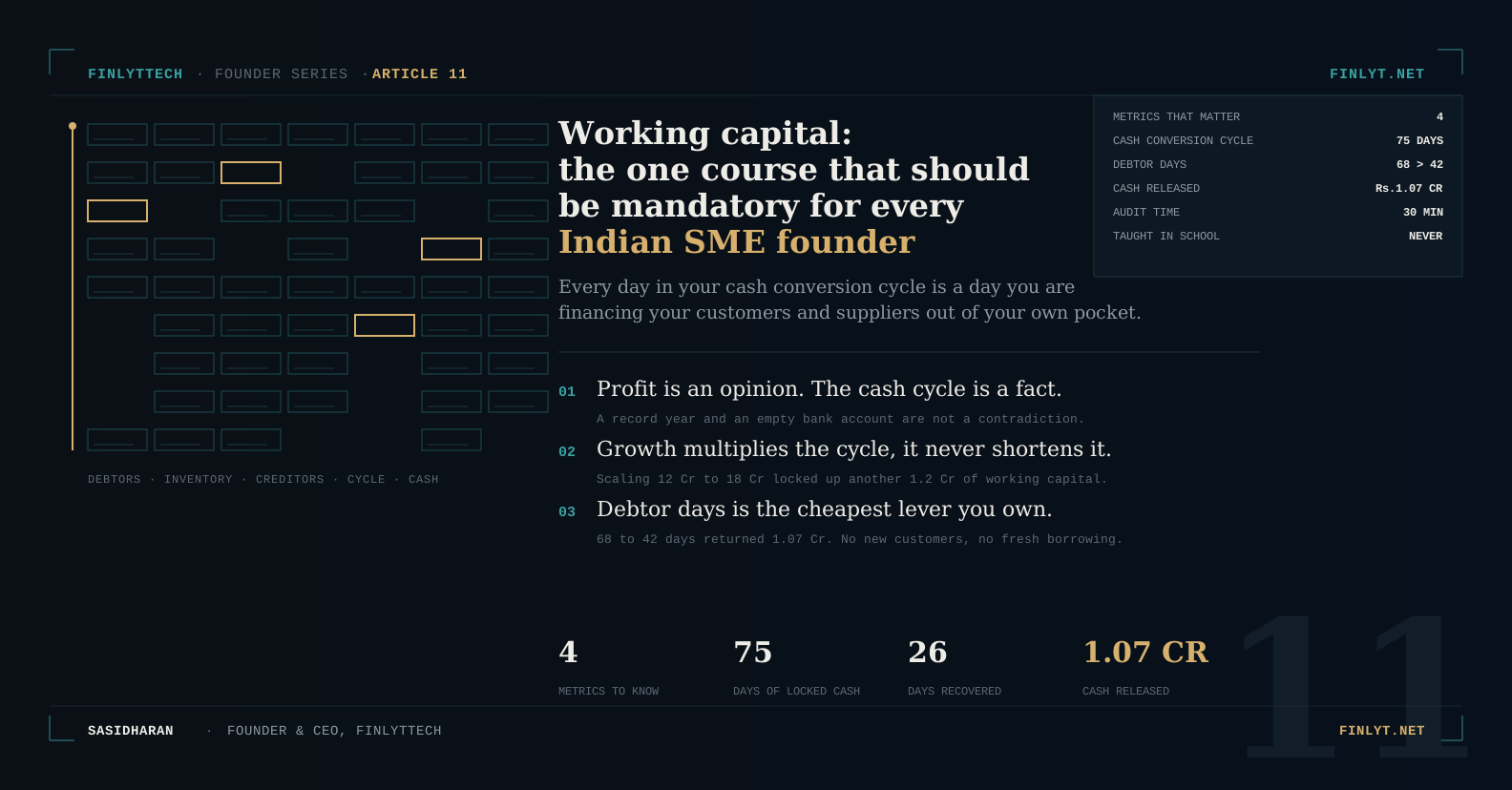
Working capital management: the one course that should be mandatory for every Indian SME founder
I have met founders running ₹40 crore businesses who could quote their gross margin to the decimal and had no idea what their cash conversion cycle was. Not because they were careless. Because nobody ever told them it was a number worth knowing.
This is the gap. An Indian SME founder typically learns finance in one of two ways – from their CA at year-end, or from a bank manager during a facility renewal. Both conversations are necessarily narrow. The CA is engaged to get compliance right, and does. The banker is engaged to assess risk, and does. Neither engagement is designed to teach a founder how the cash inside their own business actually moves. So the founder learns pricing, learns sales, learns hiring – and never learns the one financial skill with the highest return per hour invested.
What founders are actually never taught
Ask a founder how the business is doing and you will get a revenue number. Ask about profitability and you will get a margin. Both are P&L answers, and the P&L is the statement founders are most exposed to and least often misled by – it is the one their CA walks them through every year.
The working capital position is different. It does not appear as a single line anywhere. It has to be constructed from the balance sheet, and it explains something the P&L structurally cannot: whether the profit you earned has turned into money you can spend. A business can post its best year on record and be unable to make salary that month. That is not a paradox. That is working capital.
The four numbers that decide whether you survive growth
There are only four, and none of them require a finance degree.
Debtor days – how long, on average, customers take to pay you. Receivables divided by revenue, multiplied by 365.
Inventory days – how long stock sits before it is sold. Inventory divided by cost of goods sold, multiplied by 365.
Creditor days – how long you take to pay suppliers. Payables divided by purchases, multiplied by 365.
The cash conversion cycle – debtor days plus inventory days minus creditor days. This is the number that matters most, and it is the one most founders have never calculated. It tells you how many days your own money is out of your hands, funding someone else’s operations, before it comes back.
Every day in your cash conversion cycle is a day you are financing your customers and your suppliers out of your own pocket. Growth does not shorten that cycle – it multiplies it.
A manufacturing example, in plain numbers
A component manufacturer buys raw material, holds it 45 days through production and finished goods, sells on 60-day terms, and pays suppliers in 30 days.
Cash conversion cycle: 45 + 60 - 30 = 75 days.
At ₹12 crore of annual revenue, roughly ₹2.5 crore of cash is permanently locked in that cycle. Now the business wins a large order and grows 50 per cent. Revenue goes to ₹18 crore. Nothing about the operating model has changed – same terms, same production time – but the cash locked in the cycle rises to about ₹3.7 crore. The business has to find ₹1.2 crore of additional funding to support growth it has already won and will eventually be paid for.
This is why profitable Indian SMEs run out of cash during their best years. The order book is not the problem. The 75 days is.
Which lever to pull first
Of the three levers, debtor days is almost always the easiest to move, and creditor days is almost always the most dangerous.
Stretching suppliers buys you cash and costs you goodwill, priority in shortages, and sometimes price. Inventory days is a genuine operational project – demand planning, SKU rationalisation, supplier lead times – and takes quarters, not weeks.
Debtor days, by contrast, usually improves through discipline rather than negotiation: invoicing on the day of dispatch instead of at month-end, following up at day 25 instead of day 50, and knowing which specific customers are drifting. Most SMEs with a 60-day stated term are collecting in 75 or 80. That 15-day gap is not a commercial concession. It is an administrative one.
The 30-minute audit any founder can run
Open your Tally data and pull four figures for the last twelve months: revenue, cost of goods sold, closing receivables, closing inventory, closing payables. Compute the four metrics above. Then compute them again for the same period a year earlier.
The absolute numbers are informative. The direction is decisive. A cash conversion cycle that has moved from 62 to 78 days over four quarters is a cash crisis with a 90-day fuse, and it is entirely visible before it becomes urgent – if anyone is looking.
What 26 days is actually worth
A ₹15 crore trading business I worked with was collecting in 68 days against 45-day terms. The fix was unglamorous: an ageing review every fortnight, invoices raised on dispatch date, and a named person accountable for the four accounts that made up most of the overdue balance. Debtor days went to 42 over two quarters.
Twenty-six days on ₹15 crore of revenue is roughly ₹1.07 crore of cash returned to the business. No new customers. No price increase. No fresh borrowing. The same business, run with visibility it previously did not have.
Your CA can build this analysis for you, and a good one will – the constraint has never been capability, it has been that constructing it by hand every month competes with the compliance calendar. That is precisely the part worth automating, so the judgment gets the time instead.
When did you last run a working capital audit for your business – and do you know what your cash conversion cycle is today?
FinLytTech computes your debtor days, inventory days, creditor days and cash conversion cycle automatically each month from your Tally, Zoho Books or ERPNext data – with the trend, not just the number. See it at finlyt.net.
All the best – read this and more at the FinLytTech Blog: finlyt.net/blog