
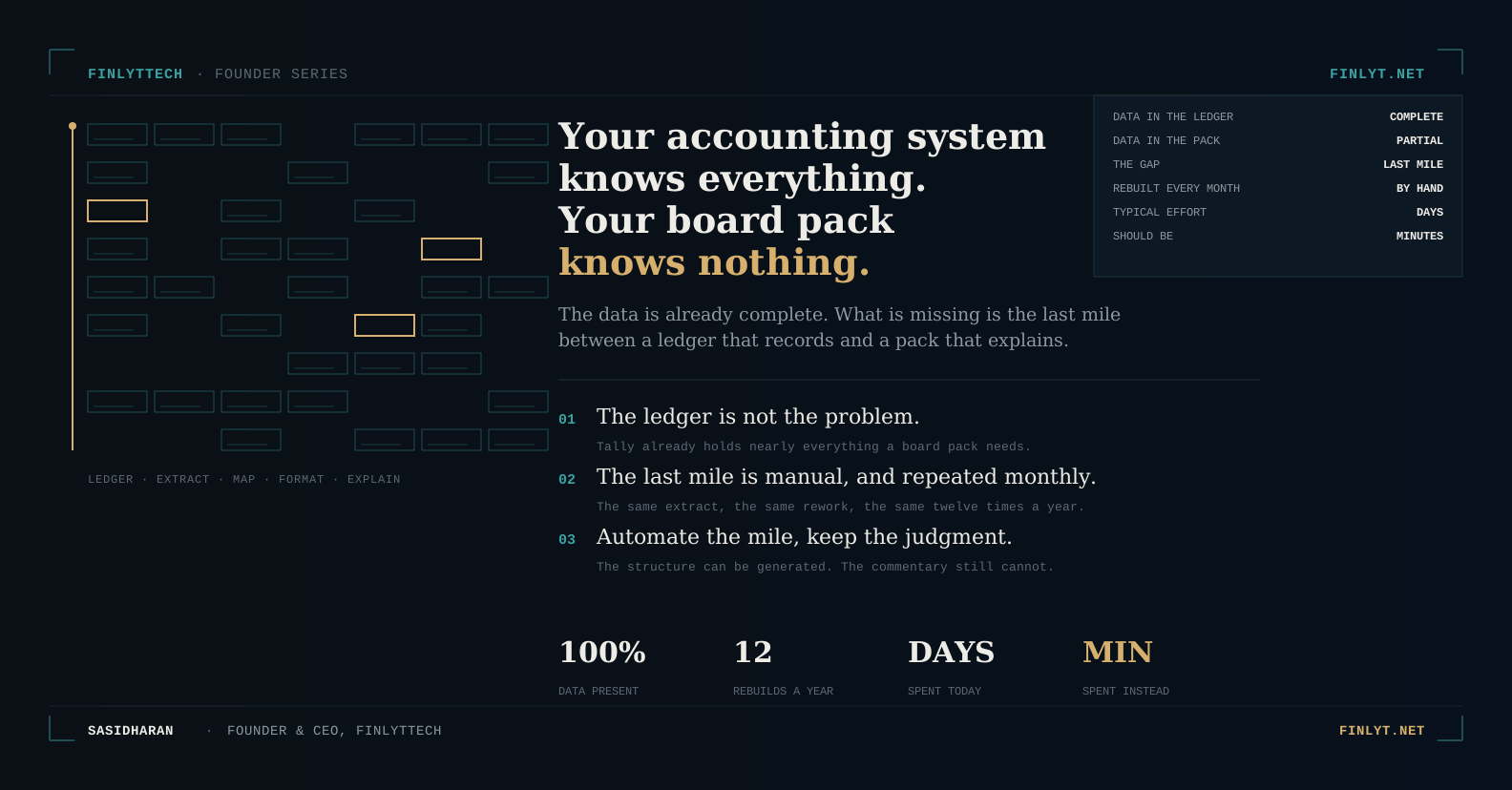
India has 63 million businesses. Fewer than 2% of them produce a structured financial report every month. This is not a technology problem. It is a system problem and it has a name.
I spent 15 years in capital markets, M&A, and FP&A. In that time, I reviewed financial packages for companies ranging from early-stage startups to listed enterprises. I sat on both sides of the table as the person asking for the numbers, and as the person responsible for producing them.
The single observation that has stayed with me, regardless of company size, sector, or geography: the quality of a company’s financial reporting rarely reflects the quality of its underlying business. Strong businesses produce weak reports. Excellent operators communicate their performance poorly. Investors make suboptimal decisions because the data arrives late, inconsistently, and without context.
In India, this gap is structural. Understanding it is the first step to closing it.
The data is already there
Let us start with a fact that surprises most people outside the finance profession: Indian businesses are actually very well-documented at the transaction level.
Tally Prime used by over 12 million businesses in India captures every sale, every purchase, every journal entry, every payment, every receipt. The data granularity in a well-maintained Tally implementation rivals enterprise ERP systems that cost 100 times as much.
Zoho Books, which serves over 750,000 Indian businesses, does the same. The transactions are there. The ledgers balance. The audit trail is clean.
The problem is not that Indian businesses lack financial data. The problem is that nobody has ever built an intelligent bridge between their accounting system and a board-ready report.
What exists today is a trial balance a raw, unformatted list of every ledger account and its balance. It is technically complete. It is practically useless for decision-making without significant human intervention.
That intervention is what we have been outsourcing to spreadsheets and CA-hours for decades.
What the last mile actually involves
Every month, across hundreds of thousands of Indian businesses, the same sequence plays out.
The accounting system closes. The trial balance is exported. An Excel file opens. A financial professional a CA, a finance manager, or sometimes the founder themselves begins the translation work that turns raw ledger data into something a board member or investor can read.
This is not simple formatting. It requires:
- Account classification — Deciding which of 200–400 ledger accounts belongs in Revenue, Cost of Goods Sold, Operating Expenses, or the Balance Sheet. This mapping is not automatic. It requires financial judgment.
- Hierarchy construction — Grouping individual ledger lines into meaningful subtotals: Gross Profit, EBITDA, Net Profit. Each grouping decision is a judgment call.
- Ratio computation — Calculating the 10–15 ratios that matter: EBITDA margin, current ratio, debtor days, inventory turnover, return on equity. Done manually from the constructed P&L and Balance Sheet.
- Variance analysis — Comparing current month to prior month, current YTD to prior YTD, and actuals to budget. Identifying what moved and by how much.
- Ageing analysis — Breaking receivables and payables into buckets: 0–30 days, 31–60 days, 61–90 days, 90+ days. Understanding collection risk and payment obligations.
- Commentary — Writing a plain-English narrative that explains what happened, what the key drivers were, and what management is watching. This is the highest-value output and the last to get done.
A skilled CA doing this for a single mid-size company typically spends 4 to 8 hours. For a CA firm serving 20 to 50 clients, this work runs through the first two weeks of every month compressed, high-stakes, and deeply manual.
| 4–8 hrs | CA-hours to build one MIS pack manually |
| 5–15 days | Typical delay from month-end to MIS delivery |
| < 2% | Of 63M Indian MSMEs with structured monthly reporting |
Why the delay is a real business cost
A MIS that arrives on the 18th of the month is reporting on the 30th of the previous month. By the time it lands in an investor’s inbox, the numbers are already three weeks old.
For a startups raising its next round, this matters. Investors form impressions quickly. A founder who can walk into a board meeting on the 5th with a clean, well-formatted MIS current month P&L, ratios flagged, debtors ageing updated, AI commentary written signals something important about how they run their business.
For an SME owner managing cash flow, the delay is more immediately costly. If your receivables ageing shows a large customer crossing 90 days, you need to know that on the 2nd of the month, not the 18th. The decision to follow up, to pause credit, or to plan an overdraft is time-sensitive.
Financial intelligence has a shelf life. A report that arrives two weeks after month-end is not a management tool. It is a historical record. The decisions it should have informed have already been made often with less information than they deserved.
What investor-grade MIS actually looks like
When I built board packs for large hospital networks and PE-backed companies, the standard was never negotiable. Investors expected the following every single month, without variation:
- A clean P&L current month actuals, YTD actuals, prior year, variance and variance percentage for each line
- A balance sheet with working capital callouts not just the numbers, but the movement
- A cash flow statement operating, investing, and financing, with a closing cash reconciliation
- 12 key ratios computed, compared to prior period, and flagged if outside normal range
- Debtors ageing customer-wise, bucketed by days outstanding, with a concentration analysis
- Creditors ageing supplier-wise, payment obligations calendar
- Stock Movements and how they can shape the Organization’s costs and Profits.
- Project / Profit centre Cost Centre wise analysis.
- A written management commentary what drove the numbers, what is being watched, what the outlook is
This is not a luxury standard. This is the minimum that any serious investor, lender, or board member expects. And for the vast majority of Indian SMEs, producing this every month is operationally impossible without significant dedicated resource.
The core insight
The gap between what Indian businesses capture in their accounting systems and what they communicate to stakeholders is not a data gap. It is an interpretation gap. Closing it does not require more data collection it requires automated, intelligent translation of data that already exists.
The tools available today and why they fall short
The honest answer is that the tools available to Indian businesses for this problem are inadequate. Not because the people building them are not talented, but because they were not built for this market.
Western AI finance tools
Platforms like Zeni, Float, and Jirav represent genuine innovation in AI-powered financial intelligence. They are well-funded, well-designed, and solve a real problem. For US companies using QuickBooks or Xero, they are excellent. They price in US dollars ($300–800/month), assume US GAAP accounting, and have no native integration with Tally Prime, GST, or Indian financial reporting formats. For the Indian market, they are the right answer to the wrong question.
Generic BI tools
Zoho Analytics and similar business intelligence platforms connect to accounting data and produce dashboards. They are powerful for companies with dedicated data teams. For a founder who needs a structured MIS pack by the 5th in the specific format that Indian investors and auditors expect they require significant custom configuration that most SMEs do not have the capability to build or maintain.
Tally Prime’s own reporting
Tally Prime’s built-in reports are excellent for compliance: GST returns, tax computation, audit-ready ledgers. For investor MIS, they produce the raw material the trial balance but not the finished output. The hierarchy, the ratios, the variance analysis, and the commentary all require human assembly on top of what Tally provides.
The India-native, AI-powered, CA-grade MIS layer simply does not exist yet as a product. That gap is the opportunity.
What changes when the last mile is automated
Consider what becomes possible when a business can upload its Tally export and receive a complete, board-ready MIS pack in under five minutes:
For the founder: The investor update that previously took a CA two days to assemble — and arrived on the 15th now arrives on the 2nd. Consistently. Every month. In a format that signals professionalism, not scramble.
For the CA: The four to eight hours of manual MIS assembly compress into a review and a sign-off. The CA’s value shifts from assembly to interpretation the work that actually requires their expertise. The same output, in a fraction of the time, at a better quality.
For the SME owner: Real-time visibility into working capital, cash position, and debtor concentration without waiting for month-end. The ability to make credit decisions, inventory decisions, and hiring decisions with current numbers, not three-week-old numbers.
For investors and lenders: Consistent, comparable MIS across portfolio companies. The ability to benchmark, flag anomalies, and intervene early rather than discovering problems two reporting cycles after they began.
The problem is being solved
The convergence of three trends makes this the right moment for this problem to be addressed properly:
First, generative AI has matured to the point where financial commentary the hardest part of MIS production can be automated at a quality that matches skilled human output. The narrative that explains why EBITDA margin compressed, or why receivables ageing worsened, can now be generated from the underlying data with the interpretive depth that investors expect.
Second, India’s GST digitisation mandate has forced virtually every significant business onto a digital accounting platform. The data that was previously locked in paper ledgers or offline spreadsheets is now accessible. The raw material for automated MIS has never been more available.
Third, the appetite for structured financial intelligence among Indian founders and SME owners has never been higher. A generation of entrepreneurs who have been through the fundraising process who know what investors expect are actively looking for tools that help them meet that standard without a full-time CFO.
The data exists. The AI capability exists. The market need is acute and growing. The only thing that has been missing is a tool built specifically for India — for Tally, for GST, for Ind AS, for INR — by someone who has done this work and understands what the output should look like.
I built FinLyt because I spent years doing this work by hand and knew it could be done differently. Not by replacing the financial professionals who make it valuable but by automating the mechanical assembly so their expertise can focus on what matters: judgment, interpretation, and advice.
If you run a business on Tally Prime or Zoho Books, or if you are a CA who builds MIS for clients every month, I would genuinely like to hear about your current process. What does your month-end MIS workflow look like? What is the biggest friction point?
Drop a comment below. I read every one.
Sasidharan — CA | MBA (IIM Ahmedabad) | Founder, FinLyt
finlyt.net
#FinancialReporting #IndianStartups #SME #TallyPrime #MIS #InvestorRelations #FinTech #IndiaFinance #StartupIndia #FPandA #CFO